
How much should you budget to build a prefab cabin in Missouri? If you focus solely on the advertised product price, you will usually see only part of the answer. Even cabins with similar floor areas can require very different total investments due to differences in materials, interior finishes, customization, and quote coverage.
This guide will help you understand the specifications and cost boundaries behind the price, identify commonly overlooked expenses, plan your budget more accurately, and avoid underestimating the true investment required during procurement.
I. How Much Does a Prefab Cabin Cost in Missouri?
For an initial estimate, factory prices for prefab cabins in Missouri can be calculated at US$60–180 per square foot. For a 1,000-square-foot cabin, this corresponds to a product budget of approximately US$60,000–180,000. Actual quotes will vary for basic shells, vacation cabins with interior finishes, and highly customized accommodation units.
As a direct manufacturer of modular buildings, Meihua prefab cabin reduces intermediary costs through in-house production, allowing you to obtain a more comprehensive configuration for the same price.
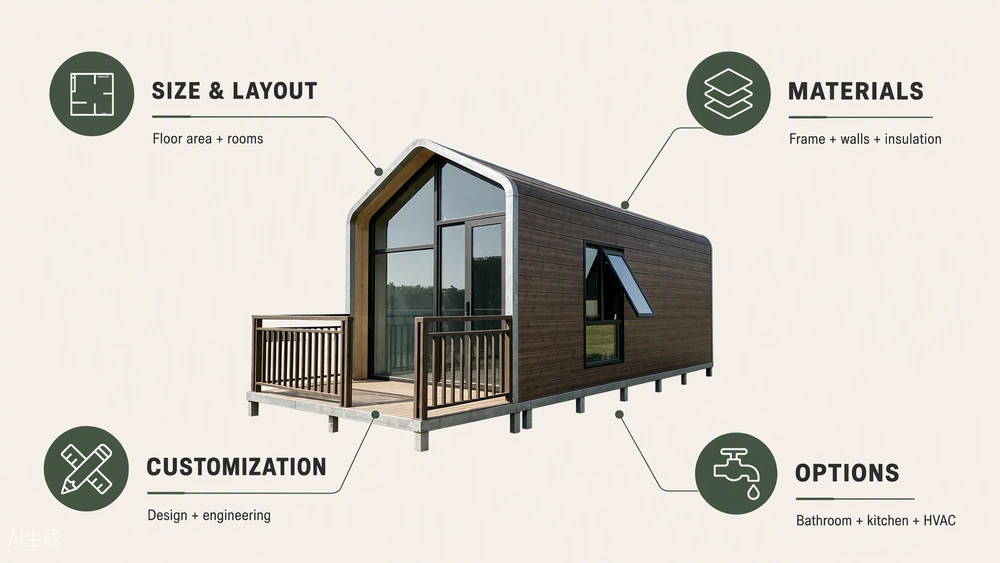
II. Prefab Cabin Cost by Size, Materials, Customization, and Options
Once you have defined your budget range, the next step is to understand the components of a factory quote. Only by understanding these cost differences can you determine which specifications are essential to meet your needs and which items can be adjusted to fit your budget.
1. Size and Interior Layout
Larger cabins generally require more materials and production labor, leading to higher prices. However, floor area is not the only factor. The number of bedrooms and bathrooms, partitions, door and window specifications, and design features such as lofts and porches also affect the final quote.
Consequently, a compact accommodation unit with a full bathroom and kitchen may cost more than a larger product without finished interiors.
2. Structure and Material Specifications
The main frame, wall and roof systems, glazing, insulation, and interior and exterior finishes all directly affect the factory quote. When comparing options, do not rely on broad labels such as ‘standard’ or ‘premium’; instead, ask the manufacturer to specify the exact material specifications and construction methods.
Taking Meihua’s standard model as an example, the main frame uses 80 × 80 × 2 mm square steel tubing, together with high-specification materials such as 12 mm OSB structural sheathing on both sides and 50 mm XPS insulation board, making the material package behind the quote clearer and easier to compare.
3. Interior Features and Building Systems
Electrical systems, plumbing and drainage, bathroom fixtures, kitchen cabinetry, HVAC, flooring, lighting, and furniture can all significantly change the overall cabin quote. Some manufacturers include these items in their packages, while others offer them as options or leave them to local contractors.
Therefore, even when cabin shells are identical, budgets can vary widely depending on the completeness of the interior package. When requesting quotes, divide specifications into ‘included,’ ‘optional,’ and ‘not included’ to avoid mistaking a shell price for the price of a complete accommodation unit.
4. Customization and Engineering Requirements
Changing colors, finishes, or parts of the layout does not require the same investment as redesigning a layout or developing an irregularly shaped cabin. Irregular exteriors, special dimensions, and nonstandard structures may require additional design work, professional structural analysis, material confirmation, and factory trial assembly.
When comparing custom proposals, confirm not only whether the desired appearance can be achieved, but also how much design and engineering work is included in the quote.
5. Order Quantity and Design Repeatability
For multi-unit projects, repeating approved unit types and specifications generally simplifies material procurement, production coordination, and future reorders. If every unit uses a different structure or nonstandard configuration, more design and manufacturing coordination will be required.
Order quantity should therefore be evaluated together with product selection, customization depth, and expansion plans. Commercial projects may consider ‘standardized core structures + differentiated exteriors and selected features’ to balance cost and distinctiveness.
III. Missouri Prefab Cabin Costs: Delivery, Site Work, Utilities, and Permits
A factory quote for a cabin typically does not equal the total cost of completing the project. Not all of the following expenses will apply to every project, but each should be reviewed before placing an order.
1. Transportation and Site Access
Verify whether the quote includes delivery to the project site in Missouri; cross-border purchases also require clarity on responsibility for ocean freight, customs clearance, and inland transportation. Check road access, unloading, hoisting, and secondary transfer requirements in advance to avoid additional expenses after the goods arrive.
2. Site Preparation and Foundation Work
Site clearing, excavation, grading, driveways, and drainage improvements may all require separate budgets. The foundation design should be based on the cabin structure, soil conditions, slope, and local requirements, rather than copied directly from another project.
3. Utility Connections and Wastewater Treatment
Having electrical systems and a bathroom in the cabin does not mean that on-site utility connections are included. Electrical service, water supply, drainage, septic systems, and wells should be assessed and quoted by local professionals according to site conditions.
4. Configuration for Local Weather Conditions
Confirm whether insulation, glazing, HVAC, moisture protection, and structural specifications need to be adapted to the project location. Instead of relying on broad ‘stormproof’ claims, define the specific issue each specification is intended to address.
5. Local Installation and Labor
Unloading, hoisting, assembly, and utility connections may be completed by different teams, so responsibilities must be clearly defined when requesting quotes. In Missouri, local labor and equipment costs can vary with project location, site accessibility, and construction scheduling, and should be calculated separately before establishing the total budget.
6. Permits and Use Requirements
Private vacation, short-term rental, and commercial accommodation projects may be subject to different land-use and approval requirements. Manufacturers can provide product documentation, but the applicability of that documentation must be verified, and it cannot guarantee local approval.
7. Other Commonly Overlooked Expenses
Furniture and appliances, porches and steps, landscape restoration, and land acquisition should be calculated separately where applicable. Insurance, taxes, and ongoing maintenance are recurring costs and should also be considered when establishing the overall budget.
IV. How Much Should You Spend on a Prefab Cabin?
A sound budget is not about finding the lowest unit price or blindly adding premium features. It is about prioritizing essential requirements within your means while avoiding overlooked project-completion costs.
1. Establish Your Total Project Budget First
Do not calculate only the purchase price of the cabin itself; also account for transportation, site preparation, foundations, installation, utility connections, and permits. For accommodation businesses, maintenance, utilities, insurance, and related operating costs should also be included in the long-term budget.
It is advisable to list ‘product procurement’ and ‘on-site completion’ separately before combining them to assess the total investment. Allow reasonable contingency for changes in site conditions and construction requirements.
2. Allocate Your Budget Based on Intended Use and Future Plans
Different uses call for different spending priorities:
- Private weekend retreats: Focus on practical layouts, living comfort, insulation, and durability.
- Glamping or short-term rentals: In addition to essential functions, consider visual appeal, guest experience, ease of cleaning, and components subject to frequent use.
- Multi-unit resorts: Balance the configuration of each unit with the overall investment while considering phased construction, future expansion, and replicable cabin designs.
If future expansion is possible, consider at the current stage whether subsequent units can use the same designs and specifications to reduce repeated development and coordination work.
3. Distinguish Essential Features from Optional Upgrades
Start by listing non-negotiable requirements, such as the number of rooms, bathrooms, kitchen facilities, insulation, HVAC, and key material specifications, before deciding which items can be upgraded. Premium finishes, large glazed areas, porches, and furniture can enhance the experience, but should not come at the expense of the structure, building envelope, and essential functions. This helps prevent the budget from being spent on appearance while leaving more important configuration gaps.
Conclusion
Overall, the true cost of a prefab cabin in Missouri is the combined result of the product price, selected specifications, and on-site project investment. Only by identifying essential features around the intended use, verifying quote boundaries, and planning local expenses in advance can you establish a more reliable project budget and reduce the risk of later additions and adjustments.
If you are evaluating a prefab cabin project in Missouri, you are welcome to contact Meihua . With our diverse in-house manufacturing capabilities, 500+ design concepts, and flexible customization services, we can provide a solution better aligned with your budget and project requirements.